Physiological science offers long-term career prospects which include research, education, management and specialised work in the field of respiratory physiology.
What is a Respiratory & Sleep Physiologist/Clinical Scientist?
Respiratory & Sleep Physiologists and Respiratory & Sleep Clinical Scientists work directly with patients to deliver diagnostic tests of breathing and provide treatment for lung and sleep-related disorders. They are often involved in exercise testing, sleep studies, ventilation assessments, and the delivery of respiratory and sleep therapies for patients both in hospital and at home.
The role of a Respiratory & Sleep Physiologist/Clinical Scientist?
Working in partnership with doctors, nurses and other healthcare professionals, Physiologists and Clinical Scientists use a variety of equipment and techniques to measure and monitor patients' respiratory and sleep function. Patients may be referred because of chest pain, abnormal chest imaging, breathing difficulties, respiratory disease or suspected sleep disorders.
Their work must be reliable and accurate, as clinical decisions and patient outcomes often depend on these assessments. They continually expand their knowledge as laboratory techniques, technology and research advance. These practitioners will often work with computers linked to sophisticated respiratory and sleep diagnostic equipment. Typical measurements and investigations include spirometry and lung volumes, respiratory gas exchange, blood gases, response to treatment, sleep studies and breathing during sleep, allergy testing, and physiological responses to exercise. Information obtained is used to support diagnosis, guide treatment plans, monitor therapeutic effectiveness, and assess risks prior to surgery.
They are also responsible for the maintenance and calibration of all equipment, including therapeutic or diagnostic devices issued for home use, such as CPAP or ventilation equipment.
Research in respiratory and sleep medicine may involve investigations to discover new information about disease processes and contribute to the development of improved treatments and potential cures.
What does it take to be an effective Respiratory & Sleep Physiologist/Clinical Scientist?
- You will need a keen interest in science, mathematics, and human biology
- You must enjoy working with technical and specialised diagnostic equipment
- Good communication skills are essential, as you will work within a multidisciplinary team and support patients of all ages and abilities with empathy and clarity
- In some situations, you may be dealing with urgent or life-threatening conditions, so emotional resilience and a calm, methodical approach are vital
What is the difference between a Respiratory & Sleep Physiologist and a Respiratory & Sleep Clinical Scientist?
Physiologists and Clinical Scientists work closely together and share many clinical skills, but they often differ in their training pathways, scope of practice and levels of clinical responsibility. Physiologists typically complete undergraduate training focused on physiological measurement. Clinical Scientists, however, usually follow a postgraduate clinical science training programme that includes advanced academic study, in-depth research training and extended clinical competencies.
The title Clinical Scientist is a legally protected term in the UK and can only be used by those who are registered with the Health and Care Professions Council (HCPC).
Career Opportunities
Physiological science offers long-term career prospects which include research, education, management and specialised work in the field of respiratory physiology. Most employment opportunities exist within the NHS, however other opportunities do exist within Her Majesty’s Forces, university research, governmental departments and the private sector. The skills of a qualified respiratory physiologist can be used throughout the UK and may be recognised worldwide.
NHS practitioner training programme (PTP) which is an integrated BSc degree in healthcare science. This includes 50% work place training in the NHS whilst studying. Courses run at Manchester Metropolitan University and Sheffield Hallam University to name a couple! Northern Ireland and Wales follow the same scheme as England with the course being run at Ulster University and Swansea University. In Scotland there is a PTP equivalent degree, BSc in Clinical Physiology, run through Glasgow Caledonian University.
How to obtain an STP and/or HSST placement for your department:
Each year Health Education England send an email to all Trusts asking for them to express an interest in having a placement. You may get this email twice, once directly and once from the Lead Healthcare Scientist (who you hopefully know) for the Trust. This email tends to come out around August for placements in the September of the following year. It tends to be facilitated by regions and the the email comes from HEE West Midlands for Coventry/Birmingham. Below are the details for Nicola Gould, who is the representative for West Midlands however she may be able to advise you who to contact for your area to get your name on their mailing list.
Website address for different areas: https://www.hee.nhs.uk/about/how-we-work/your-area
Nicola Gould - Email: nicola.gould@hee.nhs.uk Tel: 0121 695 22
Where can I find out more?
Contacting the respiratory department of your local hospital is usually a good place to start.
Job adverts can be found in the local and national press, or on the NHS Jobs Website.
The National School for Healthcare Science offers information on which departments are able to accommodate STP and/or HSST placements.
Follow this link for more information https://nshcs.hee.nhs.uk/services/accreditation/
Working in the UK
Please click here for more information on working in the UK.
Useful Websites
Academy of Health Care Science
National School of Healthcare Science
Promote a Career in Respiratory & Sleep Physiology!
If you would like to promote a career in respiratory physiology, please click the flyers below to download and print:
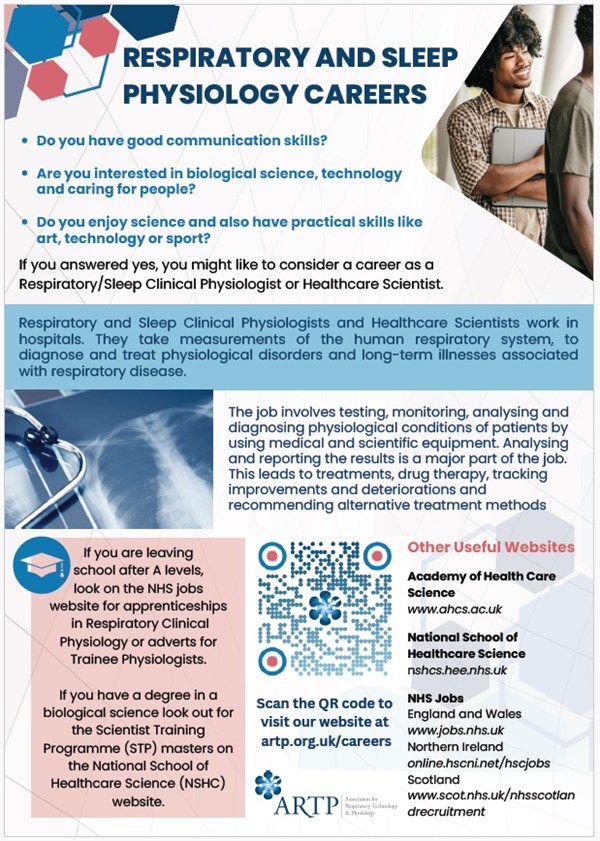
GCSE Student |
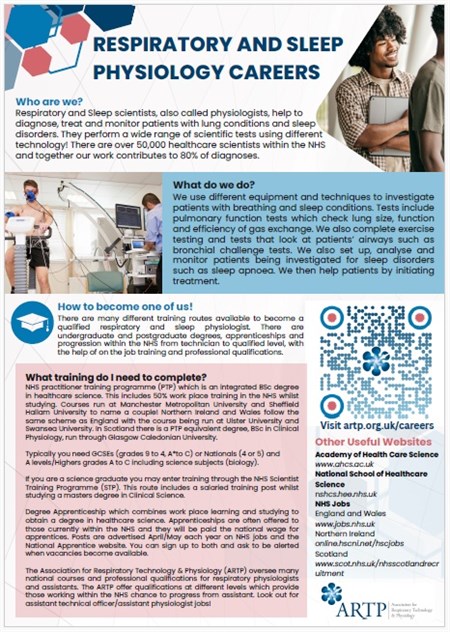
ALEVEL Student |