On the day of your examination, please make sure the equipment you are using is checked and calibrated prior to you commencing your assessment. Your assessor will be available in the week leading up to your examination if you have any queries.
There will be one assessor unless a trainee assessor needs to observe the assessment process. You should inform ARTP Administration if you object to this.
All parts will be recorded via the online platform by the assessor. This is to aid standardisation of the examination, but may be used in any future appeals. Recordings will be kept with the confidential candidate file and only reviewed if required.
As part of the ARTP Professional Qualification Technical examination, candidates are required to perform a series of tests on a volunteer patient. To ensure the examination is conducted fairly and professionally, the volunteer patient should meet the following requirements:
- Read and sign the Patient Consent Form 48 hours prior to the examination date.
- Ideally, not be a close relative or someone with a close personal relationship to the candidate, to help maintain the integrity and impartiality of the assessment.
- Not be familiar with performing the lung function test and/or the equipment/software used.
Please note that the volunteer patient does not need to be an existing patient of the candidate or their workplace. A healthy volunteer is acceptable, provided they meet the requirements above and give informed consent.
Running Order
- Your patient should wait outside the room and your examiner will introduce themselves and let you know what you will need to do for the examination.
- You should be wearing any PPE needed (as per your local guidelines) but not your mask (if wearing one for testing) so that your assessor can check your identification against another form that you will need to present to the camera. You can then put your mask on ready to start once identity has been confirmed.
- Try to speak loudly and clearly saying what you are doing as you go as though you are teaching someone.
- Once you call your patient in and they enter the room, your examination starts.
- You will be required to carry out the specified tests indicated below:
- Measurement of Heart Rate and Oxygen Saturation using Pulse Oximetry
- Spirometry
- Pre test assessment of the patient including height and weight measurement.
- VC, FEV1, FVC, FEV1/FVC ratio, PEF
- Bronchodilator administration: Placebo* via Metered Dose Inhaler or using a real inhaler without actuating it. *Unless patient had acute (or emergency) clinical requirement.
- Total Lung Volumes
- FRC or TGV, RV, VC, ERV and TLC measurements
- Transfer Factor
- TLCO, KCO, VA
- We expect the practical element to take a maximum of 60 mins. If there are technical difficulties, then extra time will be given corresponding to the time taken to fix the problems. If more than 2 gas transfer measurements need to be undertaken, then a further 5 minutes per extra gas transfer (up to a maximum of an extra 15 minutes for performing 5 measurements) will be given by your assessor.
- The examination will be recorded online (by the assessor) and ideally offline (by you) as well in case of technical issues.
- Once you are happy that you have completed everything required in the practical examination, your patient can leave the room.
- You may then be asked a couple of questions to clarify something that may have arisen during your examination.
- After the questions (if applicable), the examiner will stop recording. You should then write any comments on your report.
- If the practical assessment is not completed within 60 minutes (or extra if technical issues arose), the assessor will end the examination and the paperwork will be completed to reflect that the assessment was incomplete.
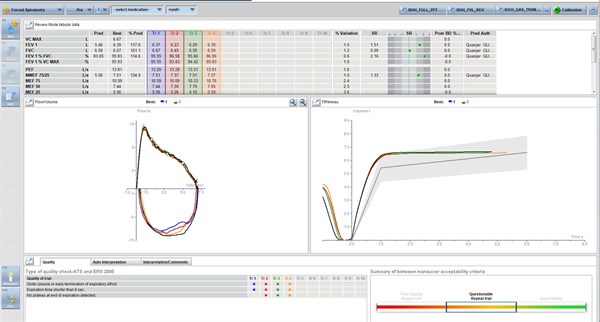
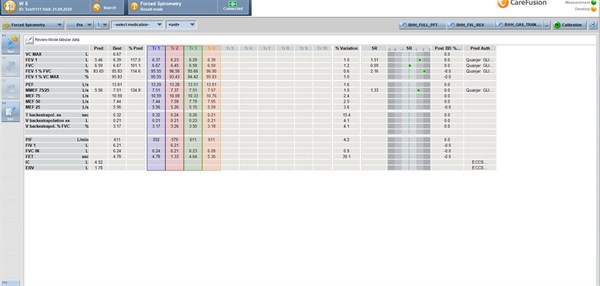
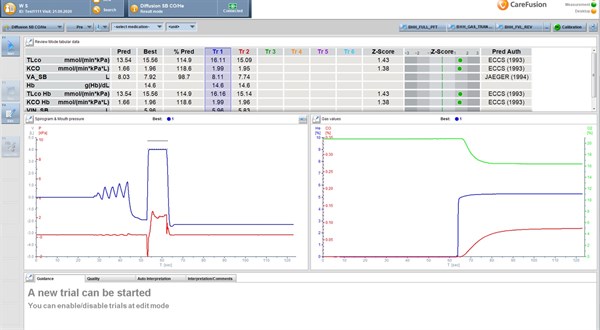
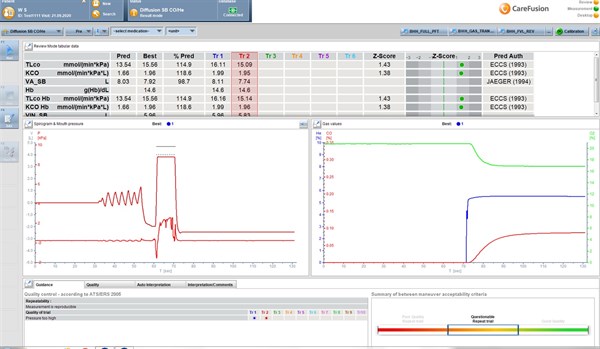
- You will be given 30 mins to take screen shots/snippets/pictures of the required values and manoeuvres detailed in the appendix below plus the overall report (all anonymised*) and email them to your assessor. You can doff your PPE (if needed) during this time too. This part will not be recorded but anything emailed should be time stamped where possible. *Initials, date, a false PID and age only should be used. Height, weight, smoking history etc are fine to be on the report.
Appendix 1. Snippets/Screen shots/Pictures to email
- VC graphs and results (2 separate snippets/screen shots/pictures)
- FVC graphs and results (2 separate snippets/screen shots/pictures)
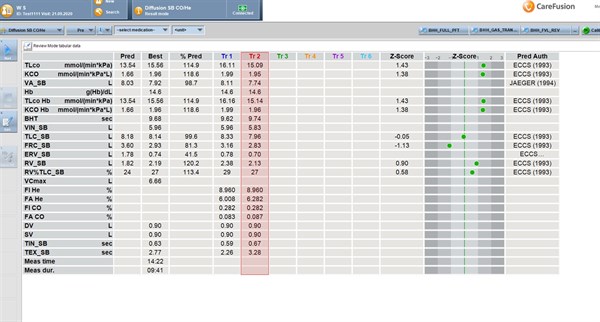
- Gas transfer graphs (2) and results (1) (3 separate snippets/screen shots/pictures in total)
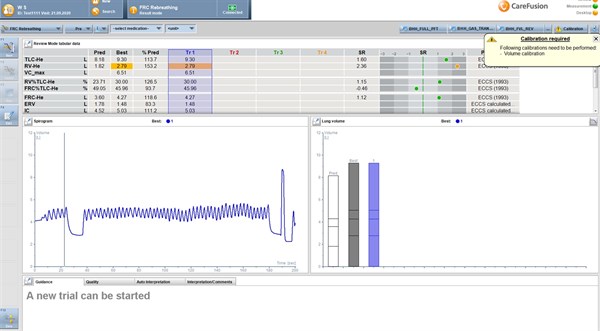
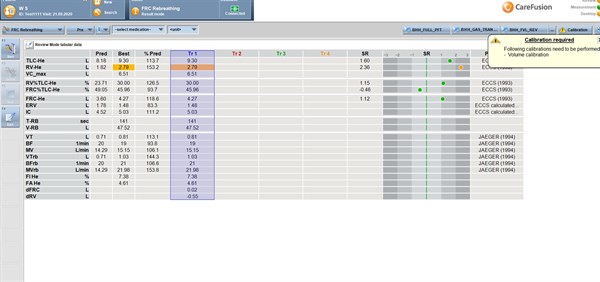
- Lung volumes graphs and results (2 separate snippets/screen shots/pictures or more if using bodybox so can see manoeuvres)
- A final report of all the measures made and the values you would report including any comments.
Please see examples of snippets/screen shots below.